
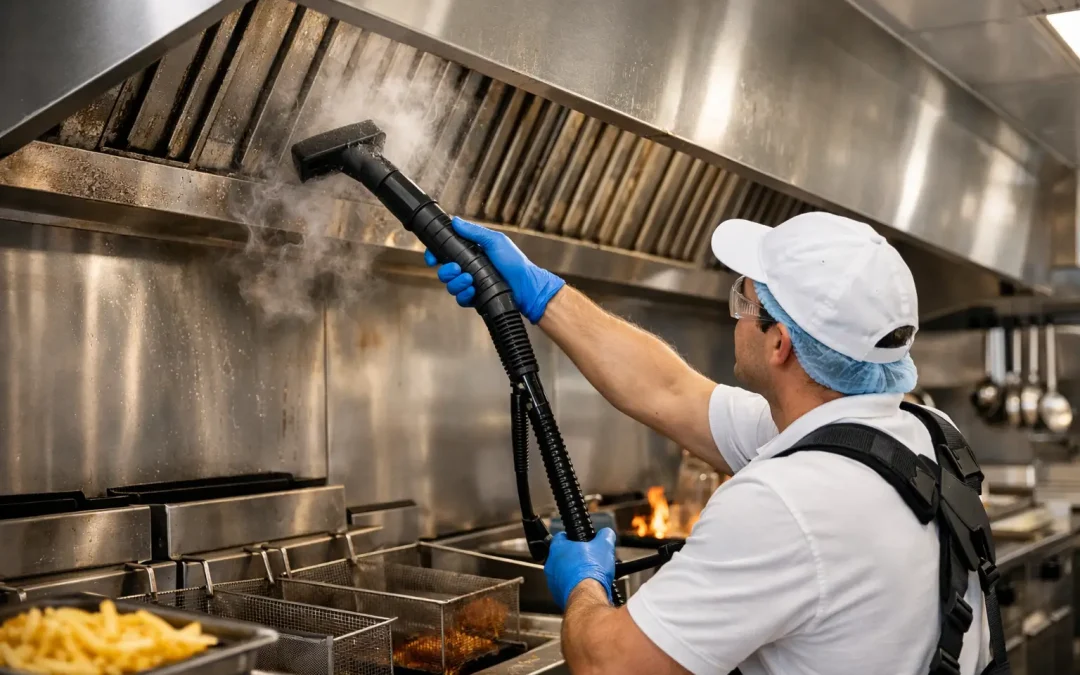
Friday night service is flat out, orders are stacking up, and the kitchen is running hot. If your canopy, filters and ductwork are loaded with grease, extraction cleaning for takeaway kitchens stops being a background task and becomes a real business priority.
For busy takeaways, the extraction system does far more than remove steam and cooking smells. It helps manage heat, supports cleaner air, reduces grease build-up on surfaces and plays a key part in fire safety. When that system is neglected, the whole kitchen feels it. Staff work in a hotter, less comfortable space, equipment gets dirtier faster, and grease begins to collect where you cannot always see it.
Why extraction cleaning matters in a takeaway kitchen
Takeaway kitchens usually work harder than many standard commercial kitchens. Long opening hours, repeated frying, high heat and limited downtime all put extra pressure on the extraction system. Even with regular day-to-day wiping and cleaning, grease does not just stay on visible surfaces. It travels upwards into filters, the canopy, risers, ducts and fans.
That matters for two main reasons: hygiene and safety. Grease deposits are not only unpleasant, they are combustible. The more build-up you have inside the system, the greater the fire risk. A dirty system can also affect airflow, which means smoke, heat and odours are not extracted as effectively as they should be.
There is also the practical side. A takeaway depends on speed, consistency and a clean working environment. If extraction performance drops, staff notice it quickly. The kitchen can become hotter, smellier and harder to work in, especially during peak periods.
What extraction cleaning for takeaway kitchens usually includes
A proper service goes beyond wiping the outside of the canopy. The visible metalwork is only one part of the system, and often not the part with the heaviest grease build-up.
Professional extraction cleaning for takeaway kitchens typically covers the canopy interior, removable filters, accessible ductwork and the fan unit. The goal is to remove grease deposits from the full system as far as access allows, not just improve appearances. That distinction matters. A shiny canopy front can still hide heavily contaminated ducting behind it.
In many takeaway kitchens, the dirtiest areas are the ones operators rarely see during normal service. Grease builds up gradually, and because it is out of sight, it can be easy to assume the usual cleaning routine is enough. In reality, extraction systems need specialist attention at set intervals.
Signs your system needs attention sooner rather than later
Sometimes the warning signs are obvious. Filters may be visibly clogged, smells may linger in the kitchen or front counter area, or the canopy may feel sticky even shortly after cleaning. In other cases, the signs are more subtle.
If the kitchen feels unusually smoky, if heat seems to hang in the room, or if staff are complaining that airflow is poor, the extraction system may no longer be working efficiently. You may also notice grease collecting more quickly on walls, ceilings and nearby equipment. That often points to a system that is not pulling as it should because internal components are restricted by build-up.
It also depends on the type of cooking you do. A business focused heavily on frying, grilling or high-volume wok cooking will usually need more frequent cleaning than a site with lighter use. There is no one-size-fits-all answer. The right schedule depends on output, cooking methods and hours of operation.
The difference between routine cleaning and specialist extraction cleaning
Most takeaway owners already have a daily or weekly cleaning routine. That is essential, but it should not be confused with specialist extraction work. Staff can and should clean accessible surfaces, but internal ducting and fan areas need the right equipment, safe access and proper attention to detail.
This is where many kitchens fall behind. They assume that because the filters are being washed and the canopy is being wiped, the whole system is being managed. In reality, grease continues to accumulate deeper into the extraction run. Over time, that can undermine the value of all the good cleaning work happening elsewhere in the kitchen.
A professional clean is designed to tackle the areas standard kitchen cleaning cannot properly reach. It is a more thorough process, and for a busy takeaway, that level of cleaning is not a luxury. It is part of responsible maintenance.
Fire risk, compliance and protecting the business
For takeaway operators, a grease-laden extraction system is not just a maintenance issue. It is a business risk. Fire can spread rapidly through contaminated ductwork, especially in kitchens where cooking is fast-paced and heat levels are consistently high.
A clean system supports safer operation. It can also help demonstrate that you are taking reasonable steps to maintain the premises properly. For landlords, tenants, managers and business owners, that matters. Nobody wants avoidable problems caused by something that could have been dealt with as part of a regular cleaning plan.
If you manage more than one site, or you are responsible for a rented commercial unit, specialist extraction cleaning also gives you a clearer picture of how well the kitchen is being looked after. It is a practical way to protect the condition of the property as well as the people working in it.
How often should extraction cleaning for takeaway kitchens be done?
This is the question most operators ask, and the honest answer is that it depends. A takeaway with heavy daily frying and long opening hours will usually need more frequent cleaning than a quieter kitchen with lighter output. The volume of grease generated is the biggest factor.
What matters most is not picking an arbitrary date and hoping for the best. It is setting a realistic schedule based on how your kitchen actually operates. If you wait until the signs are obvious, the system is already overdue attention.
For many takeaway kitchens, a planned maintenance approach works best. That means arranging extraction cleaning at sensible intervals rather than reacting when the canopy starts looking dirty or the kitchen becomes uncomfortable. Planned cleaning tends to be easier to manage, less disruptive and more cost-effective over time.
What to look for in a professional provider
Not every cleaning company is set up for specialist extraction work. Takeaway operators should look for a provider that understands commercial kitchen environments, works safely, and carries out the job thoroughly rather than offering a quick visual tidy-up.
Clear communication matters. You want to know what parts of the system are being cleaned, what access is possible, and whether there are any areas that need follow-up attention. A fully insured company offers extra reassurance, particularly in active commercial premises where safety and accountability are non-negotiable.
It also helps to choose a team that understands how local businesses work. In busy parts of Kent, including Maidstone and Medway, takeaway kitchens often need cleaning arranged around trading hours to keep disruption to a minimum. A practical service should fit around the realities of the business, not add to the pressure.
The wider benefits of a cleaner extraction system
A professionally cleaned extraction system can improve more than safety alone. Better airflow can make the kitchen a more comfortable place to work, which matters during long shifts. It can also help reduce the spread of grease and odours through the premises, making general cleaning easier between deep cleans.
There is a presentational benefit too. Customers may never see inside your ductwork, but they notice if a takeaway smells stale, feels stuffy or looks like grease is settling everywhere. Standards behind the scenes tend to show through in the customer experience, even when they are not looking directly at the source.
For owners trying to protect equipment and maintain a high standard across the kitchen, extraction cleaning supports the bigger picture. It is one of those services that often prevents more problems than it visibly solves.
If your takeaway kitchen is working hard every day, the extraction system should not be left to chance. Keeping it properly cleaned is one of the simplest ways to protect your staff, your premises and your day-to-day operation – and that peace of mind is worth planning for.